


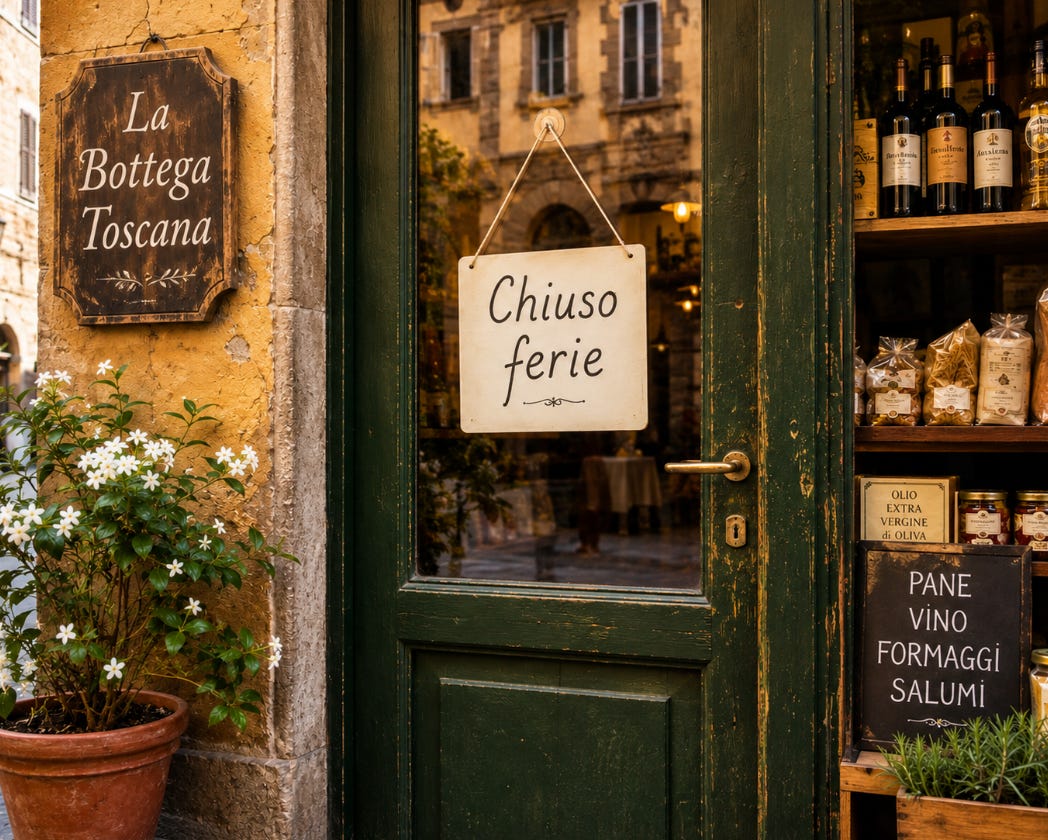
It’s August 15, a national public holiday in Italy. It’s Ferragosto.
It’s both a public holiday and a deep cultural ritual marking the peak of the Italian summer. Briefly today, the entire country seems to pause. I’ll tell you a little about Ferragosto, and then I’ll close shop, my laptop, in my case, and just like a good old Italian would do, I’m off.
Believe it or not it sounds like it was Emperor Augustus, who introduced the Feriae Augusti as a period of rest after the agricultural season. Centuries later, August 15 became associated with the Catholic feast of the Assunzione di Maria.
Mussolini also had his saying into it. In 1930 the government introduced the treni popolari, low-cost holiday trains that allowed working-class families to travel to the seaside, mountains and other destinations. This helped cement Ferragosto as Italy’s great summer getaway tradition.
But, it’s not only on August 15 that you might get no service or find three-quarters of the retail stores and offices closed. This goes on pretty much the entire month of August.
You arrive somewhere and find a closed door. Or, if it is open, an employee will politely explain that it’s August and certain services are simply not available because most people are on vacation. And perhaps, in solidarity with his absent colleagues, he too will decide not to serve anyone.
You learn to slow down. Their explanation?
“Ma è agosto!”
But it’s August! Of course that should explain everything.
And you know what? In Italy, somehow it does.
So, my friends, when in Rome, do as the Romans do. I’m closing my laptop and doing something many Italians are really good at.
Enjoying the time off.
See you next week, when I’ll tell you about a very special library in Siena.
And talking about Siena, tomorrow August 16th it’s Palio day. The most celebrated event in the city and probably in the region. To read my last newsletter about the Palio click Here
Buon Ferragosto!
Tino
Buon Ferragosto! Italians have the right idea!
There is a version of this from the other side of the closed door, and it explains more than the holiday does. Whether a place opens in August is not decided by demand, it is decided by deliveries. The bread for the fifteenth is ordered days before, and if the baker, the fishmonger and the greengrocer all shut in the same week, a dining room can be full of willing customers and still have nothing to cook. So the August calendar of an Italian city is written by its suppliers, and the places that stay open are the ones who spent the spring making sure somebody would still be driving a van. Two things about Milan usually surprise people watching from outside. The city does not empty, it changes inhabitants: the commuters leave, the residents who work stay, and the people who arrived from elsewhere eat here every single day. And the average bill goes down in August rather than up, because those are two different publics and they order differently. Enjoy the time off, and I will read about the library in Siena from behind a counter that does not close.