
No One Knocked
Los Angeles didn’t shout at me, It hummed.

A low, continuous hum, technology in motion, efficiency without warmth, movement without presence. During my stay in Los Angeles, I had the quiet feeling that I wasn’t simply visiting a city, but stepping into a rehearsal of what may soon become our everyday world.
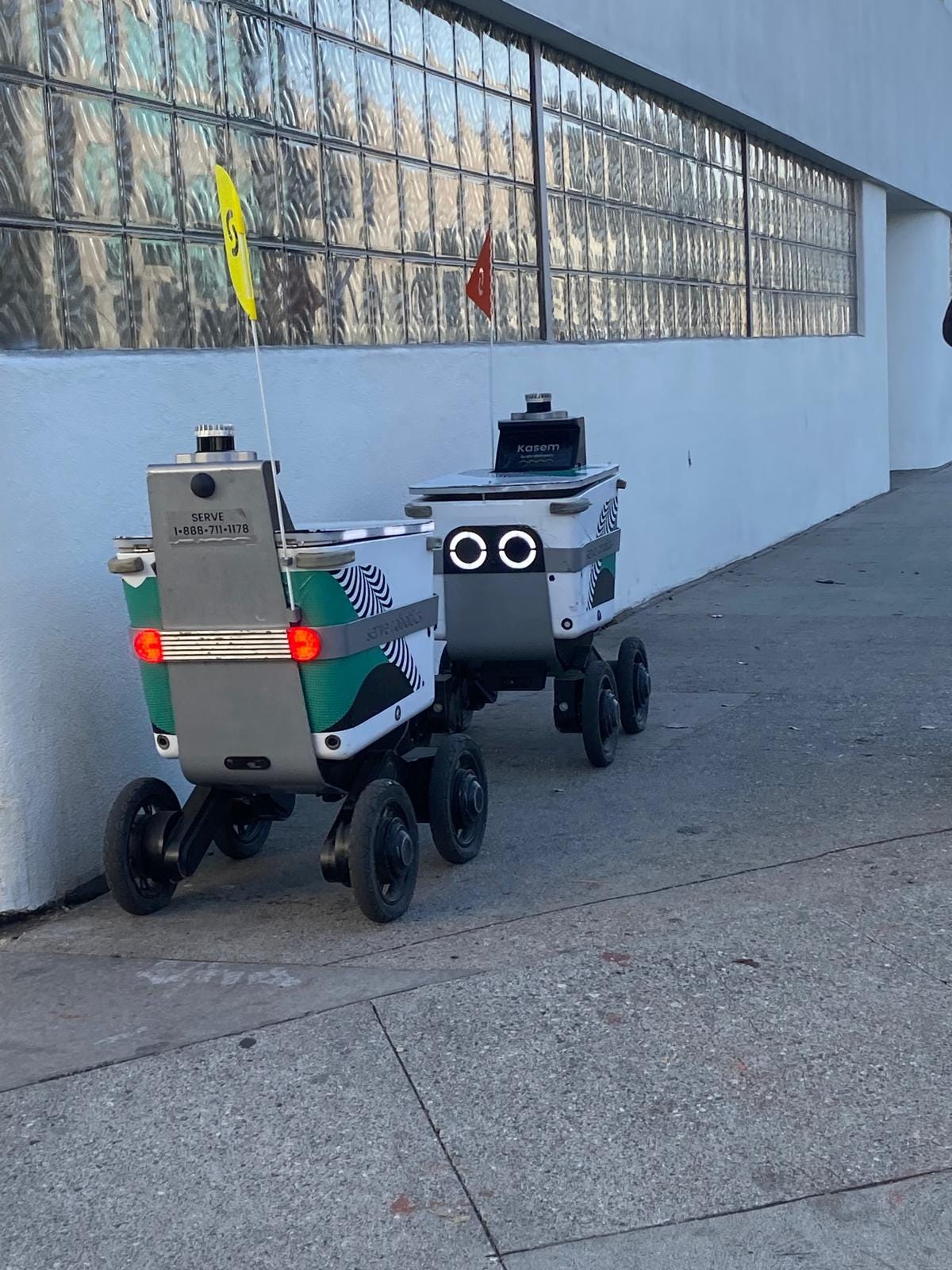
Waymo taxis glide through the streets, driverless and silent. Delivery robots roll along sidewalks like obedient insects, carrying meals and packages without ever meeting a human gaze. Amazon and its siblings have long replaced the baker and the milkman. Batteries, dog food, a printer, shopping no longer requires people, places, or conversations. Just a screen, a click, and a door that never fully opens.
Everything works.
Perfectly.
Perhaps too perfectly.
What struck me most was the passivity. No questions asked. No curiosity invited. No friction allowed. Life here seems carefully designed to reduce the need for interaction. Even spontaneity feels inefficient, something to be smoothed out, optimized, quietly avoided.
One evening, while walking along Sunset Boulevard, traffic came to a sudden stop. A car sat motionless at a red light long after it had turned green. No honking. No one stepped out. No one knocked on the window to see if the driver was alright.
I felt the urge to check, to attend to the person behind the wheel—but I hesitated. In a city I don’t know well, where involvement can turn into misunderstanding, concern feels risky.
So people waited.
And waited.
Eventually, the police arrived. They knocked. The driver was asleep.
What stayed with me wasn’t the incident itself, but the response—or rather, the absence of one. No one intervened. No one checked. Someone must have called 911, but no one crossed the invisible line between self and other. Distance seemed easier than engagement.
That distance appears elsewhere too.
Few greetings.
Little small talk.
Rare acknowledgment.
It made me wonder how many people we still call on Christmas Day.
At the entrance of my son’s building, there is no name directory, no keypad to dial an apartment. You approach with your cellphone to be recognized, to be connected. A phone is no longer just a tool, it’s a requirement. When I mentioned this to Vittorio, he looked at me with mild surprise. It’s normal, he said. And safer.
Normal.
Safe.
We text.
We scroll.
We consume.
This kind of individualism isn’t loud or defiant. It’s quiet, efficient, and contained. Everyone moves within their own bubble, highly connected, yet rarely intersecting. Interaction becomes optional. Presence, situational.
Los Angeles felt like a mirror held up to a possible future. One that is faster, smoother, smarter… and more contained.
This isn’t a judgment.
It’s an observation.
Some time ago, reading Ikigai, I was struck by how often long lives are built not on comfort or efficiency, but on being quietly entangled in other people’s days. On being expected. On being noticed.
What lingers with me now is the thought that as our lives grow smoother and more autonomous, they may also grow thinner. Less interrupted. Less shared. Less held.
Perhaps the risk isn’t that technology will replace us, but that it will gently remove the reasons we once had to knock, to ask, to wait, small gestures that reminded us we were not moving through the world alone.
And maybe longevity, like meaning, has less to do with how well things work… and more to do with how often we still reach for one another.
May the year ahead be efficient where it must be—but human where it matters.
Happy New Year,
Tino
L’homme est résilient. Il s’adapte assez facilement aux nouveautés, aux changements, aux catastrophes…. Cela est étonnant et fascinant. On peut se demander s’il s’adaptera à sa disparition. D’ici là, on a encore de belles années à vivre dans nos montagnes. On a hâte de t’y voir.
Plus nous vieillissons plus c’est vrai…….bonne réflexion
Merci Tino et Bonne Année 2026