

Walking With Fernanda
The Quietest Love Story

There are love stories that fill books, movies, and songs.
And then there are the quiet ones.
For years, while sitting at my favorite café in Piazza Arnolfo or wandering the narrow streets of Colle Val d’Elsa, I would often see an elderly couple.
He was always pushing her wheelchair.
She sat quietly, her gaze fixed somewhere far away, as if she were looking at a world invisible to everyone else.
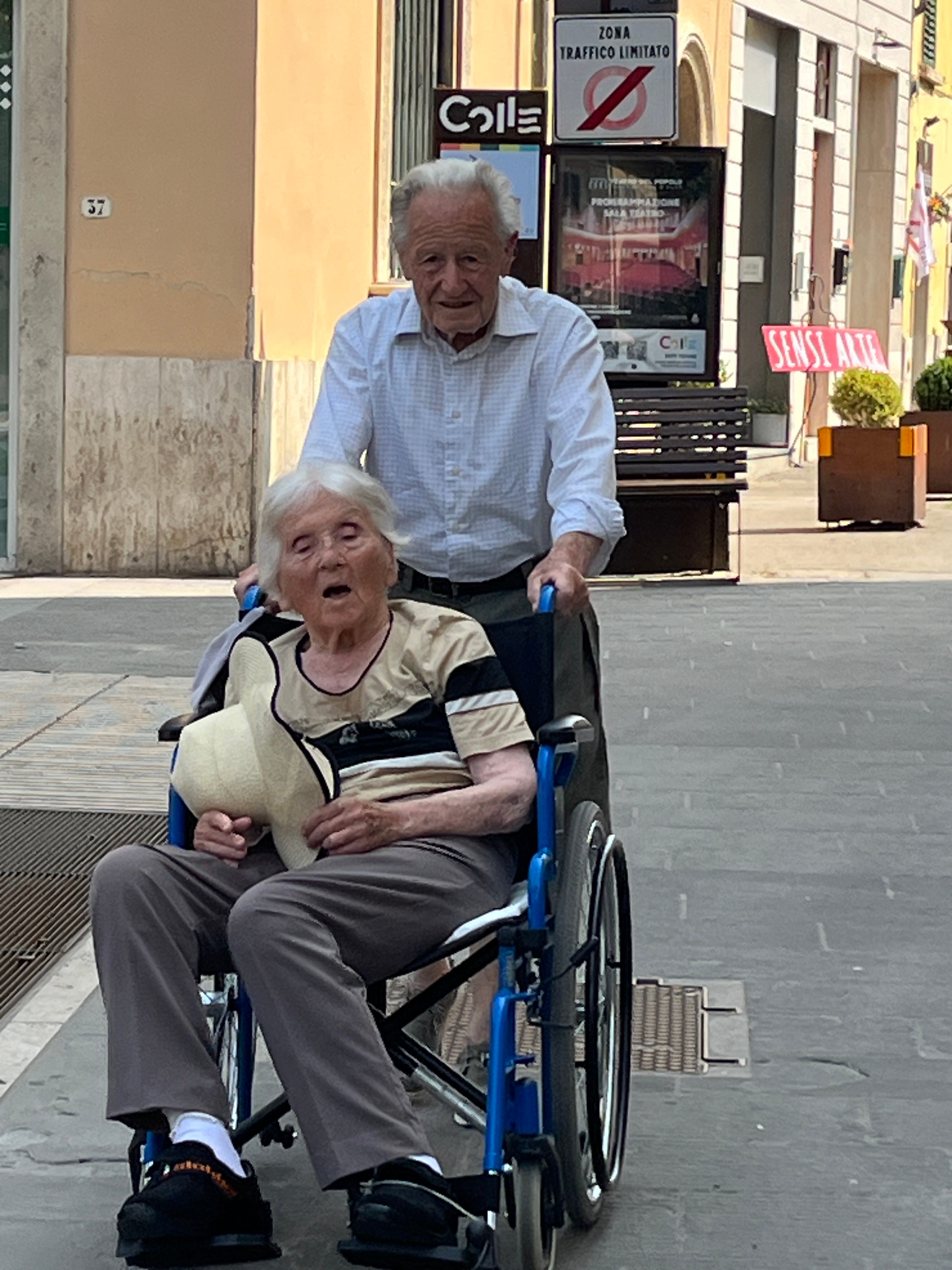
I saw them in every season.
During the scorching heat of August, when the stones of the old town seemed to radiate warmth from every direction, I would often see him feeding her gelato.
During the cold winter months, bundled beneath layers of coats and scarves.
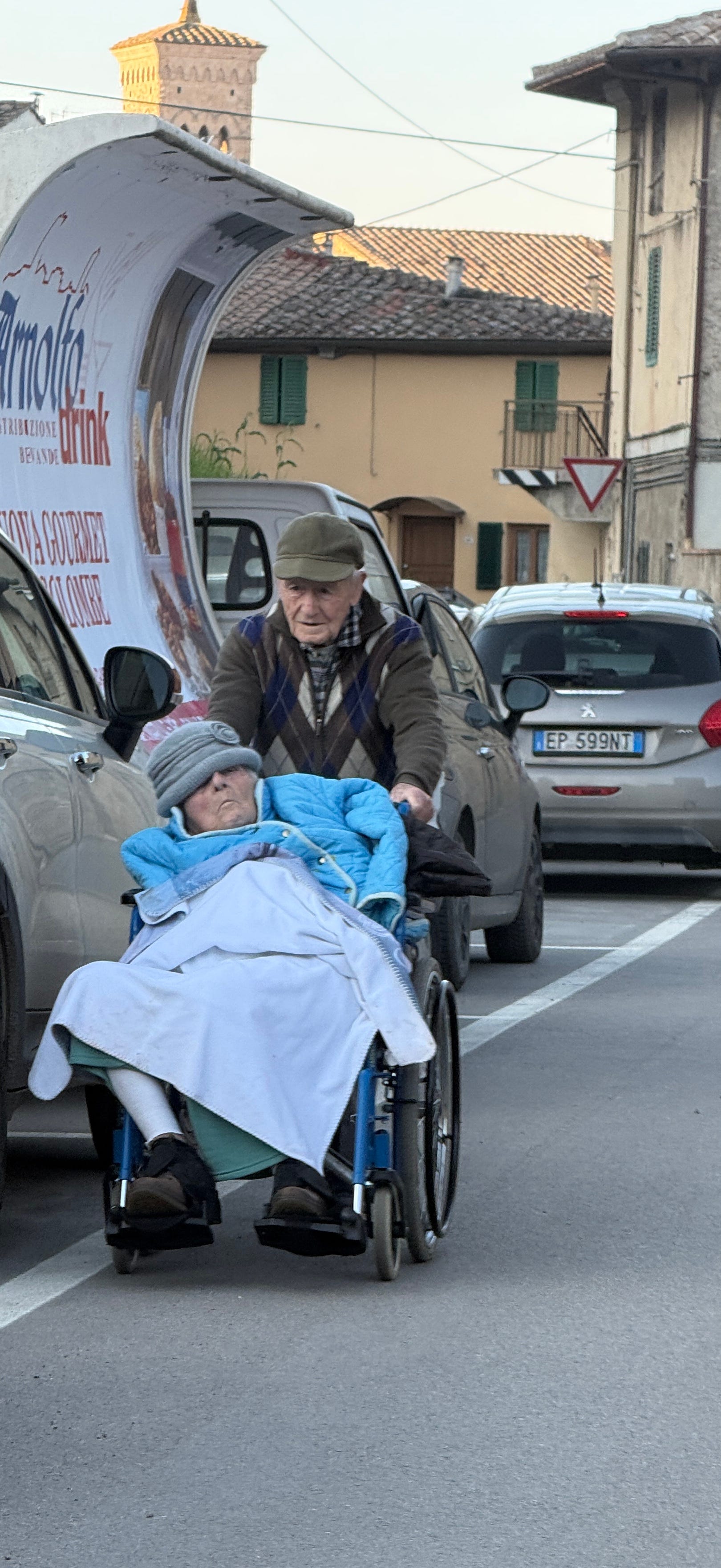
On rainy days, moving slowly over the wet cobblestones.
Always together.
Always the same routine.
I knew nothing about them, yet I found myself strangely attached.
I often wondered what invisible thread kept them moving through the years with such quiet determination.
Many times, I thought about stopping them and introducing myself.
But I didn’t. I felt I would be intruding on their peaceful time.
Instead, I simply watched from a distance and admired them.
I even secretly took a few pictures because one day I wanted to write about them.
But not without their permission.
If several days passed without seeing them, I would find myself wondering whether they were alright.
Then, a few weeks ago, I saw him.
Alone.
No wheelchair.
No companion beside him.
His usual cheerful expression seemed absent.
When I returned home, I mentioned it to Emi.
“I saw the gentleman today,” I said. “He was alone.”
My mind immediately went where minds often go.
But Emi, eternal optimist that she is, quickly interrupted.
“Just because she wasn’t there doesn’t mean something happened,” she said. “Maybe she wasn’t feeling well. Maybe she was in the hospital. Don’t assume the worst.”
I hoped she was right.
Today, on my way to the bakery, I saw him again.
Still alone.
This time I crossed the street.
I finally gathered the courage I had lacked before.
“Buongiorno, signore,” I said. “I’ve seen you and your lady walking through town for a long time. I’ve always admired you both, especially the undivided attention you gave her. But I haven’t seen her lately. Is everything alright?”
He looked at me quietly.
His eyes immediately filled with moisture.
“La signora non c’è più.”
My wife is gone.
The words landed heavily.
I asked if he minded if we walked together for a while.
We slowly made our way down Via Garibaldi.
At first, he seemed hesitant to talk to me, but once he warmed up, he was eager to tell me his story.
Loreano, was born in 1935 in Colle Val d’Elsa, he had worked as an electrician for most of his life. His wife, Fernanda, was seventy-eight when she passed away.
His stories about the war, when he was just a boy, were vivid and animated. He pointed to the doorway of the house where he had lived and explained how his family had been forced to abandon it and seek refuge in caves outside the town. When he and his family returned, the house had been completely destroyed by the bombardments.
I asked him how he managed to stay so fit.
“I walk every day,” he replied.
Rain or shine.
“It used to be ten kilometers,” he told me with a smile. “Now, much less.”
He met Fernanda in 1967.
They married the following year.
Nearly sixty years ago.
Then his voice softened.
She had developed Alzheimer’s disease years earlier.
“She never left my side,” he said.
And then he corrected himself.
“No. I never left hers.”
He dressed her every morning.
Prepared every meal.
Helped her eat.
Took her for walks through town.
Day after day.
Year after year.
“I did everything I could for her,” he said quietly. “I did my best. She was everything to me.”
For a moment neither of us spoke.
The sounds of the town continued around us. Conversations floated from nearby cafés. A scooter passed. Church bells rang somewhere in the distance.
“Now I’m alone,” he said.
There was no bitterness in his voice.
Only acceptance.
Then he said something that stayed with me long after our conversation ended.
“I know my time is approaching,” he told me. “But I would never want to know when it will come.”
He paused.
“Because even if that date were far away, knowing it would give my life an ending.”
Another pause.
“I would rather live each day fully without thinking about the future.”
When we reached the point where our paths separated, I shook his hand and said:
“Until next time, Loreano.”
He smiled gently.
Then he replied:
“Please, make sure you say hello to me if we meet again.”
I looked at him, puzzled.
“Because,” he said, “I may not remember you next time.”
I stood there watching him walk away.
Alone.
Yet somehow not alone.
Because every step still seemed to carry Fernanda beside him.
I subscribed to your publication just today, and halfway through reading this, a wave of gratitude washed over me. I kept thinking: what luck that I found this today, otherwise I would have never known about Fernanda and Loreano.
Thank you for crossing the street, Tino. You didn't just walk with Loreano down Via Garibaldi; you brought all of us along to walk right beside him, too. Anyone who reads this will carry a piece of their story from now on.
Tino a beautiful story about unconditional love, it brought a tear to my eye.